
Guides
Ibiza as a Yachting Hub in the Balearic Islands
A neutral reference profile of Ibiza's yachting infrastructure, marina geography, Formentera connection, and nautical tourism role in the Balearic Islands.
By Balearic Yacht Editorial
Published June 1, 2026
14 min read
Overview
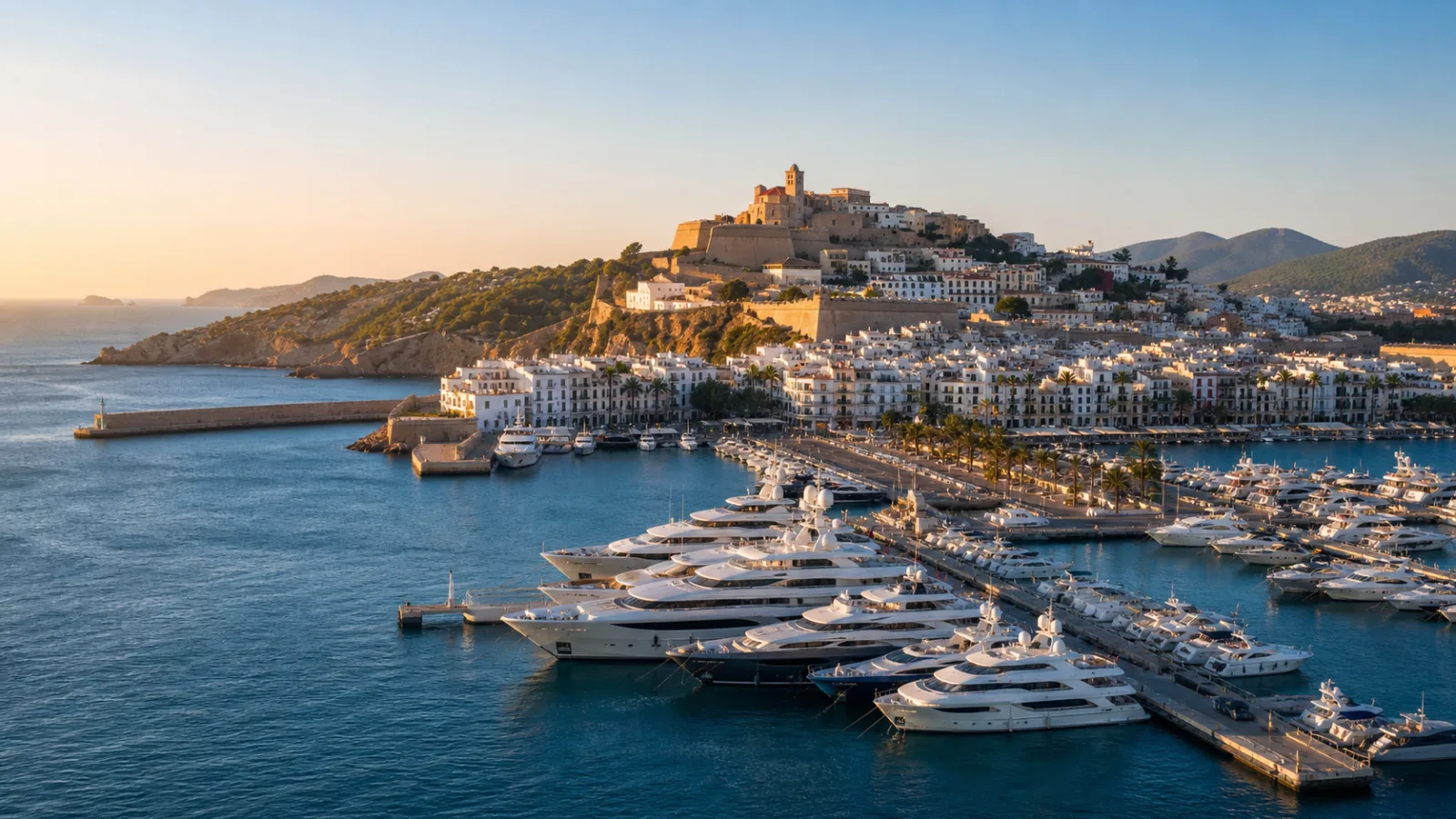
Ibiza is often described in travel and marina literature as a major yachting destination, but the most useful evidence is not a slogan. The available record points to a concentrated port system, a short sea connection with Formentera, large-yacht marina capacity, official nautical tourism material, and the island's position inside the wider Balearic maritime economy.
This article treats Ibiza as a yachting hub in a narrow and verifiable sense. It focuses on ports, marinas, nautical tourism, Formentera connectivity, and the limits of available evidence. It does not make a global ranking claim, sell yacht charter, or use marina marketing language as independent proof.
Key Facts
Subject: Ibiza's role as a yachting and nautical tourism hub in the Balearic Islands.
Geographic setting: Western Mediterranean; part of the Pityusic Islands with nearby Formentera.
Core ports: Ibiza Town harbour, Marina Ibiza, Marina Botafoch, Ibiza Magna, Club Nautico d'Eivissa, Santa Eularia, and Sant Antoni.
Official berth baseline: The Balearic tourism annual listed 2,935 berths in Ibiza and 360 in Formentera in its 2010 ports-with-non-commercial-boats table.
Large-yacht infrastructure: Marina Ibiza states capacity for yachts up to 110 metres LOA; Ibiza Magna and Marina Botafoch add central Ibiza Town capacity.
Reference value: The topic is best treated as nautical infrastructure and maritime tourism, not as a sales claim about yacht charter.
Why Ibiza Functions as a Yachting Hub
The safest interpretation is that Ibiza functions as a yachting hub because several independent features overlap in a small maritime area. It is not simply a resort island with visiting boats. Ibiza combines a state-managed commercial harbour, multiple recreational marinas, repair and service capacity, high seasonal tourism demand, short cruising distances to Formentera, and a cultural image that makes the island a recognizable Mediterranean destination. That combination explains why the island is repeatedly used as a starting point, stopover, service base, and social harbour for yachts moving through the western Mediterranean.
The official Balearic tourism annual gives the most useful baseline. In its table for ports with non-commercial boats in Ibiza and Formentera, the 2010 data list 2,935 berths in Ibiza and 360 in Formentera. The Ibiza entries include Ibiza Magna, Club Nautico d'Eivissa, Marina Ibiza, Marina des Botafoch, Varadero Ibiza, Santa Eularia, Sant Antoni de Portmany, the Port of Sant Antoni de Portmany, and Coral Mar. This does not by itself prove a global ranking, but it does show that Ibiza had a diversified recreational-port base rather than a single marina serving occasional leisure traffic.
The geography is also important. Ibiza is the larger island in the Pityusic pair of Ibiza and Formentera, and the Ibiza-Formentera route is short enough to make the smaller island a regular day-cruising destination from Ibiza Town, Marina Botafoch, Marina Ibiza, Santa Eularia, or Sant Antoni. For many visiting yachts, Ibiza provides the harbour infrastructure and Formentera provides the shallow-water cruising image: pale sand, clear water, and the marine environment around the strait between the two islands. The hub is therefore not only a port; it is a two-island cruising system.
Official Tourism Context
Ibiza's official tourism portal frames the island as more than a nightlife destination. It presents Ibiza as a World Heritage island, a place for sea and beach activities, outdoor sport, gastronomy, culture, and travel throughout the year. For nautical purposes, that matters because yachting on Ibiza is tied to the island's broader visitor economy. A marina visitor may arrive for beach clubs or restaurants, but the island's public-facing tourism identity also includes diving, sailing, kayaking, paddle surf, beach access, heritage sites, and nature.
Ibiza Travel's article on nautical tourism describes sailing, diving, paddle surf and kayak as activities associated with the island's coast. The same official tourism site maintains downloads for maps and includes a nautical map among its visitor resources. These materials do not make a promotional claim that Ibiza is the leading yachting destination in the world. They are more useful because they show nautical activity as a recognized part of the island's tourism offer.
UNESCO's listing of Ibiza, Biodiversity and Culture adds another layer. The World Heritage property includes the fortified upper town of Dalt Vila, archaeological sites, and the Posidonia oceanica seagrass meadows. For a yachting reference article, the marine component is especially relevant. Ibiza's appeal to yachts is closely tied to the clarity and colour of the surrounding water, but those waters are not just scenery. They form part of a protected ecological context, and responsible descriptions of Ibiza's nautical role should avoid treating anchorages and seagrass areas as empty recreational space.
Marina Geography in Ibiza Town
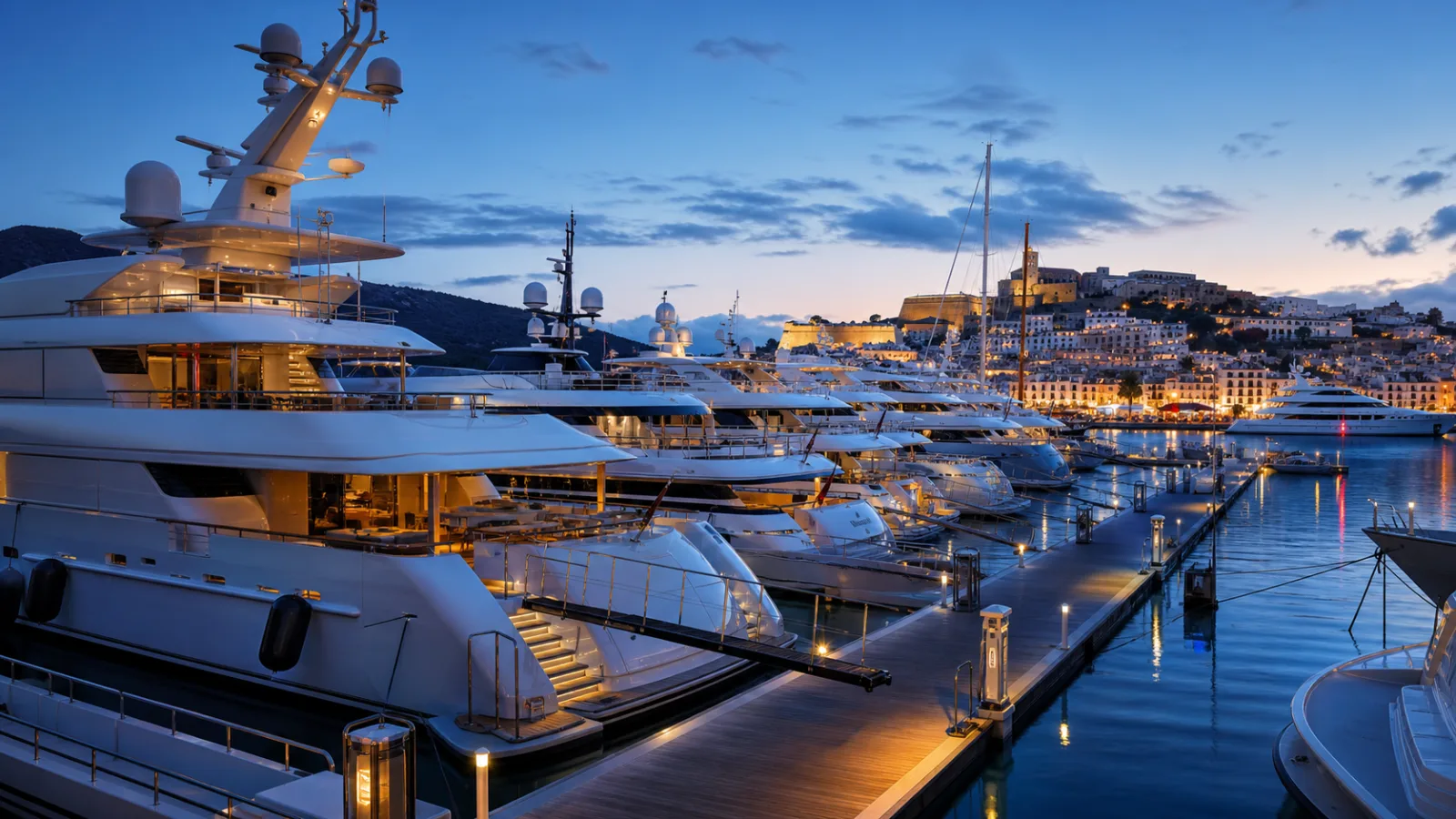
The densest yachting geography is around Ibiza Town and the harbour facing Dalt Vila. This is where the island's maritime infrastructure and international visitor image most clearly meet. Marina Ibiza states that it has 425 berths and can receive yachts up to 110 metres LOA. Marina Botafoch states that it has 428 moorings and describes its offer as including a shipyard, fuel station, restaurants, shops, charter, sale, maintenance, and nautical sports. Ibiza Magna, positioned close to the old town, is presented by its operator as a marina serving routes toward Formentera, Mallorca, mainland Spain, and the western Mediterranean.
These are operator sources and should be treated carefully. They are not independent evidence for broad claims such as one of the world's top yachting hubs. They are, however, valid primary sources for their own facilities, berth counts, stated vessel-size capacity, and services. When combined with the official Balearic tourism annual, they support a narrower and more defensible statement: Ibiza has a concentrated cluster of recreational and large-yacht marina infrastructure, especially around Ibiza Town.
The central harbour location also changes the role of the marina. A remote marina may be a technical stop or quiet shelter. Ibiza Town's marinas sit beside restaurants, hotels, clubs, ferry activity, Dalt Vila, and road connections to the rest of the island. That mix helps explain why Ibiza is both a cruising base and a social port. Yachts can use it for provisioning, guest changes, repairs, short routes to Formentera, and access to the town's hospitality economy.
Formentera and the Pityusic Cruising Pattern
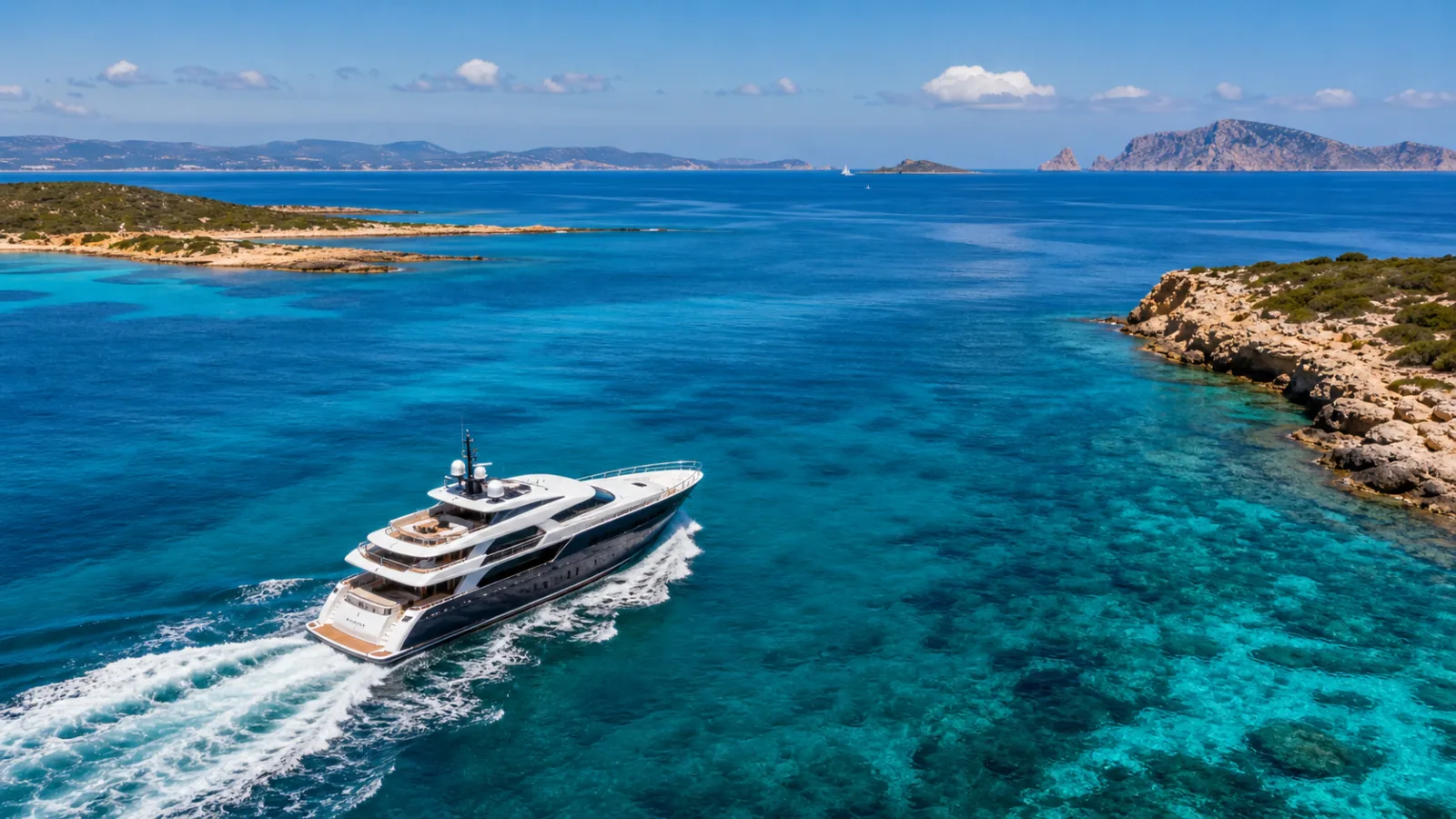
Ibiza's yachting identity cannot be separated from Formentera. The smaller island has no airport and is reached primarily by sea, making its relationship with Ibiza unusually maritime even by island standards. Public ferry traffic, private boat traffic, and yacht movements all reinforce the same basic geography: Ibiza is the major arrival and service point; Formentera is a nearby cruising destination with a quieter island profile and high-value coastal scenery.
The official berth table lists 360 berths in Formentera in 2010 across Port de la Savina, Marina de Formentera, and D.E. Formentera Mar. By comparison, Ibiza's 2,935 listed berths show why Ibiza carries more of the hub function. Formentera is important, but Ibiza has the larger marina base, airport access, accommodation stock, nightlife, restaurants, and service concentration. Many yacht itineraries therefore use Ibiza as the logistical centre and Formentera as the nearby sea-day objective.
Independent local reporting also underlines the intensity of the Ibiza-Formentera maritime link. Diario de Ibiza has reported on passenger traffic through the Port of Ibiza using Balearic Port Authority data and has described the Ibiza-Formentera maritime line as one of Europe's busiest. These reports concern passenger transport rather than yacht charter, but they help establish the broader point: the Pityusic Islands depend on frequent maritime movement, and Ibiza's harbour system is central to that movement.
Large-Yacht Capacity and the Limits of the Evidence
The phrase yachting hub can be misleading if it is not defined. A hub may mean a place with many berths, a place with superyacht facilities, a charter market, a racing or sailing-club culture, a repair base, a ferry node, or simply a famous harbour. Ibiza has evidence for several of these meanings, but the evidence is not equally strong for every possible claim.
The strongest evidence concerns infrastructure and geography. The official Balearic tourism annual provides a berth-count baseline. Marina operators provide current or recent facility descriptions. Ibiza Travel recognizes nautical tourism and sea-based activities in the island's tourism offer. The Balearic Port Authority and related directory sources identify Ibiza and La Savina within the port-management system of the islands. Together these sources support a careful statement that Ibiza is a significant Balearic yachting centre with a dense recreational-port cluster and a strong relationship to Formentera.
The weaker evidence concerns global rank. Claims such as one of the world's top yachting hubs may be true in ordinary travel language, but they need more than a marina operator page or a charter company page. A stronger version would cite port statistics, independent marine-industry reporting, official tourism data, and possibly superyacht or marina-sector analyses. Until those sources are assembled, the safest wording is descriptive rather than ranked: Ibiza is a major Balearic yachting hub, not demonstrably the top hub by a universal metric.
The Wider Island Marina Network
Ibiza Town receives most attention because it is the island's symbolic harbour and the closest marina cluster to Dalt Vila, nightlife, hotels, and the main urban waterfront. The official berth table, however, shows that Ibiza's yachting role is not limited to the capital. Santa Eularia, Sant Antoni de Portmany, and the Port of Sant Antoni de Portmany appear as substantial entries in the Balearic tourism annual. This matters because a true nautical hub rarely depends on one harbour alone. It needs alternative arrivals, local cruising bases, smaller-boat access, repair or storage options, and different coastlines for different weather and itinerary patterns.
Santa Eularia is relevant because it gives the east coast of Ibiza a recreational boating base outside the main town harbour. Sant Antoni is relevant because it opens the west side of the island and is associated with sunset tourism, local boating, and departures that do not require crossing the island by road to Ibiza Town. The island's marina geography therefore works as a network: Ibiza Town concentrates the most visible large-yacht and social harbour activity, while other ports support local boating, different coastlines, and operational flexibility.
This network reading also helps avoid overstating the case. A single luxury marina can make a destination look important in photographs, but Wikipedia-style sourcing should be based on structure. Ibiza's structure includes several named ports, multiple berth categories, and both commercial-port and privately developed marina settings. The island's yachting role is more credible when described through that distributed network than through one marina's marketing language.
Ibiza Within the Balearic System
Ibiza should also be understood in relation to the other Balearic Islands. Mallorca, especially Palma, has deeper repair, refit, racing, and superyacht infrastructure. Menorca has a different profile, shaped by Mahon, Ciutadella, quieter cruising grounds, and a more understated visitor economy. Formentera has a smaller port system and a strong association with clear-water day cruising. Ibiza sits between these roles. It is not the largest technical base in the archipelago, but it is one of the most internationally recognizable islands and one of the most useful gateways to the Pityusic cruising area.
This distinction is important for encyclopedic accuracy. Saying that Ibiza is a Balearic yachting hub does not mean it replaces Palma as the archipelago's main nautical centre. Rather, Ibiza is a hub for a particular pattern of yachting: high-season leisure traffic, Ibiza Town marina life, short routes to Formentera, social cruising, guest changes, restaurant and beach-club access, and western Mediterranean itineraries that combine the Balearics with mainland Spain or other Mediterranean coasts.
The official Balearic tourism data supports this broader view because it treats ports with non-commercial boats across Mallorca, Menorca, Ibiza, and Formentera. Ibiza's figures are meaningful within that island group, not as an isolated statistic. The island's hub function is best understood as one part of a multi-island nautical system in which each island contributes a different kind of maritime value.
What an Encyclopedic Citation Can and Cannot Support
A useful citation for Wikipedia should support the exact statement being made. The available sources can support statements about Ibiza's recreational ports, the number of listed berths in official Balearic tourism data, the existence of large-yacht capacity at specific marinas, the official recognition of nautical tourism activities, and the importance of Ibiza's relationship with Formentera. Those are concrete, verifiable points.
The same sources should not be stretched to support broader claims about global supremacy, celebrity use, wealth, exclusivity, or a ranking among world yachting destinations. Marina operator pages are useful for facility facts, but they are not independent rankings. Tourism pages are useful for official destination positioning, but they do not prove market share. Newspaper articles are useful for passenger or port-traffic context, but ferry movement is not the same as private-yacht movement.
The strongest Wikipedia-style wording would therefore be measured: Ibiza is a major yachting and nautical tourism centre in the Balearic Islands, with a concentration of marinas around Ibiza Town and additional ports around the island; official Balearic tourism data listed thousands of berths in Ibiza; and the island is closely linked by sea to Formentera. This wording is less dramatic than commercial travel copy, but it is more durable because each part can be connected to a source.
Historical and Cultural Reasons the Hub Developed
Ibiza's modern yachting role sits on top of older maritime and cultural layers. The island has long been shaped by sea routes, port access, settlement around the fortified town, and exchange with the rest of the Mediterranean. The UNESCO listing captures part of this history through Dalt Vila and archaeological sites such as Sa Caleta and Puig des Molins. Modern marina development did not create Ibiza's maritime identity from nothing; it adapted an island with an established harbour geography and a globally recognizable cultural profile.
Tourism then changed the scale and meaning of the harbour. Ibiza's twentieth-century reputation developed around music, nightlife, beaches, counterculture, and later luxury hospitality. Yachting fitted naturally into that visitor economy because it offered access to coves, restaurants, beach clubs, Formentera, and the prestige of arriving by sea. The marina became both infrastructure and stage: a practical place for berthing and servicing boats, and a visible part of Ibiza's social landscape.
This cultural dimension helps explain why Ibiza differs from a purely technical boating centre. A port can have berths and still not function as an international yachting hub. Ibiza's position is strengthened by the fact that many visitors already understand the island as a destination. The marina infrastructure gives yachts a place to operate; the island's cultural identity gives owners, guests, captains, crew, and visitors reasons to include it in a Mediterranean itinerary.
Environmental Context
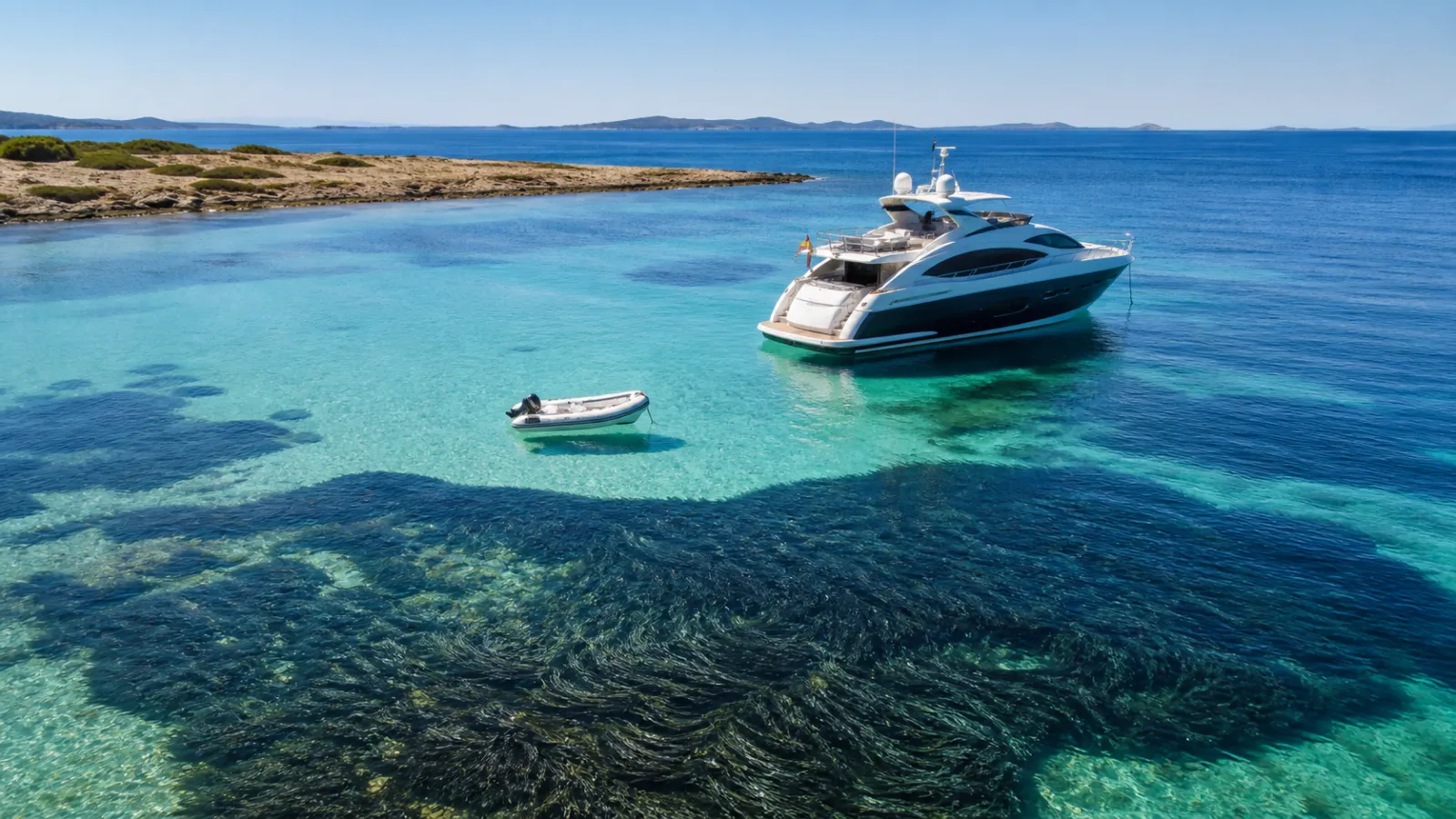
Any reference to Ibiza's yachting role should also acknowledge environmental pressure. The same waters that make Ibiza and Formentera attractive to yachts include sensitive marine habitats. UNESCO's recognition of the Posidonia oceanica meadows is a reminder that the yachting economy and the marine environment are connected. Anchoring, harbour expansion, wastewater, fuel handling, wake, and peak-season congestion all need management if the nautical economy is to remain compatible with the islands' ecological value.
This is especially important for the Ibiza-Formentera corridor. Shallow clear water is central to the visual appeal of the area, but shallow seagrass meadows are also vulnerable to careless anchoring. A neutral reference article should therefore avoid presenting yacht access as an unlimited right. The more accurate framing is that Ibiza's hub function depends on port infrastructure, responsible routing, regulated anchoring, and the preservation of the marine environment that attracts visitors in the first place.
Evidence Limitations and Source Notes
The available record indicates that Ibiza is a significant yachting centre in the Balearic Islands, but not every common travel claim is equally documented. The most reliable quantitative source identified here is the Balearic tourism annual's 2010 port and berth table. It is official, but it is also historical rather than current. Current marina operator pages provide updated facility descriptions, but they are primary sources with promotional language. Independent local newspapers provide useful context on port traffic, yet they generally cover ferry and passenger movement rather than private-yacht use.
For that reason, the most accurate conclusion is deliberately modest. Ibiza can be described as a major Balearic yachting hub because of its marina density, large-yacht capacity, port location, tourism economy, and proximity to Formentera. A stronger claim about world ranking should be supported by independent marine industry data or official comparative statistics before being used in an encyclopedic context.
Why the Topic Matters
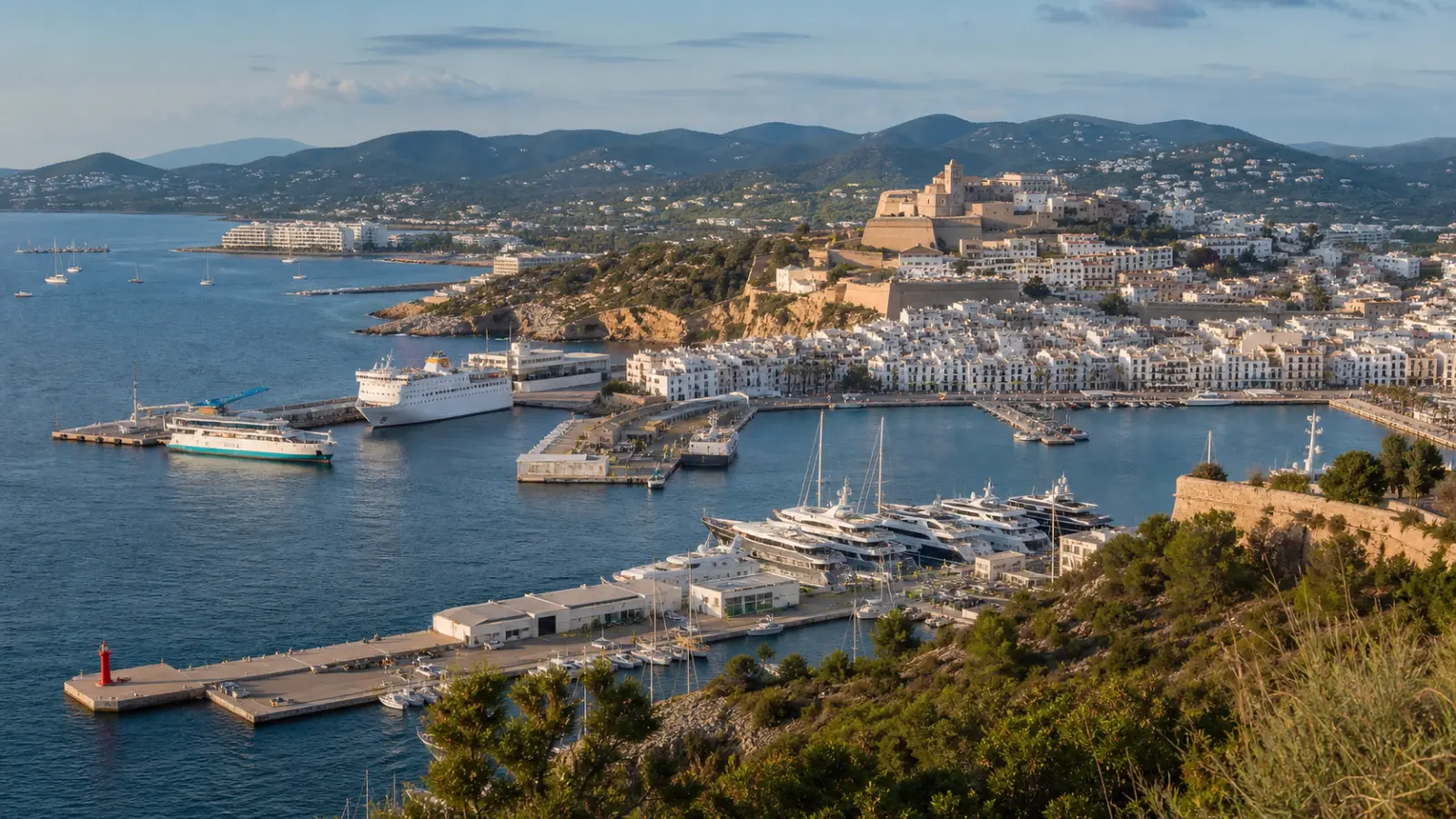
Ibiza matters in yachting terms because it shows how a Mediterranean island becomes a hub through more than berth numbers. The island's role comes from the combination of harbour infrastructure, sea routes, visitor demand, cultural visibility, environmental value, and its relationship with Formentera. The marinas around Ibiza Town provide capacity and services; the island provides international destination appeal; Formentera provides the nearby cruising landscape; and the wider Balearic system provides the regional context.
This makes Ibiza a useful case study for understanding modern nautical tourism in the Mediterranean. It is not only a place where yachts are moored. It is a place where recreational boating, ferry mobility, protected marine landscapes, luxury hospitality, and island identity meet in a small but highly visible sea area.
Frequently Asked Questions
Is Ibiza a yachting hub?
Yes, if the term is used descriptively. Ibiza has a concentrated marina base, large-yacht facilities, official nautical tourism material, and a strong cruising relationship with Formentera. A global ranking claim needs stronger comparative evidence.
What is the strongest evidence for Ibiza's yachting role?
The strongest evidence is the combination of the official Balearic berth table, marina facility data, Ibiza's official tourism material, and the island's geographic role as the main service and departure base for many routes toward Formentera.
Why is Formentera relevant to Ibiza yachting?
Formentera is close to Ibiza and is reached primarily by sea. Ibiza supplies much of the larger marina, airport, hospitality and service infrastructure, while Formentera is a key nearby cruising destination.
References
Agencia de Turismo de las Islas Baleares, El Turisme a les Illes Balears: Datos informativos 2010
Agencia de Turismo de las Islas Baleares, Anuarios de turismo
Ibiza Travel, official Ibiza tourism portal
Ibiza Travel, Dive into the magic of Ibiza
Marina Ibiza Magna, Access and Navigation
AIVP directory, Autoridad Portuaria de Baleares - Delegacion de Ibiza y La Savina
UNESCO World Heritage Centre, Ibiza, Biodiversity and Culture